So, how do you declare medication at the airport? And do you really need to declare your medication at the airport?
You don’t need to declare your medication on domestic flights. However, it is always wise to have your prescription ready and make sure that your medicine is in its original packaging. Medicine in liquid form over 3.4 oz / 100ml will need to be screened separately, but they are not limited to the TSA 3-1-1 liquid rule.
If you are flying internationally, you will need to declare your medications and it is preferable to have them in their original packaging. You should first check if the medication is allowed in the country of your destination.
In this post I will cover everything you need about carrying both prescribed and non prescribed drugs and medication on planes, and how to avoid some common issues at the airport.
Let’s dive right in.
Pro Tip: Use this free cabin luggage size checker to see if your carry-on meets your airline size and weight limits.
TL;DR
- You can bring both prescribed and non prescribed medications on a plane.
- You don’t usually need to declare medication for domestic flights, but it’s best to keep prescriptions and original packaging handy for quick security screening.
- Liquid medications are allowed even more than 3.4 oz / 100 ml limit but may need additional screening.
- For international flights, you will need to declare any medications, and keep them in their original packaging.
- Always make sure that you follow the rules of your destination country before flying.
Can You Take Medications In Domestic Flights?
Do you need to declare medications at the security checkpoint?
First let’s clarify something, liquid and solid medications have slightly different rules.
You don’t need to declare solid medications like pills and tablets to the security officer, but it’s a good idea to have your prescription handy to speed up the screening process.
But for liquid medications, the rules are slightly different.
Even though the TSA liquid rule allows only 3.4 oz / 100 ml of liquids per container in carry-on baggage, there is no limit to any liquid medicine you need to take, but it still needs to undergo additional security screening.
Medication in liquid form, like Benadryl, needs to be declared to a security officer.
Here is what the TSA says about declaring medication at the airport:
It is not necessary to present your medication or notify an officer about any medication you are traveling with unless it is in liquid form.
I also wanted to find some answers from the TSA social media.
Arwyena asked the TSA on X what the policy is on traveling with medications and whether she had total their in their original bottles.
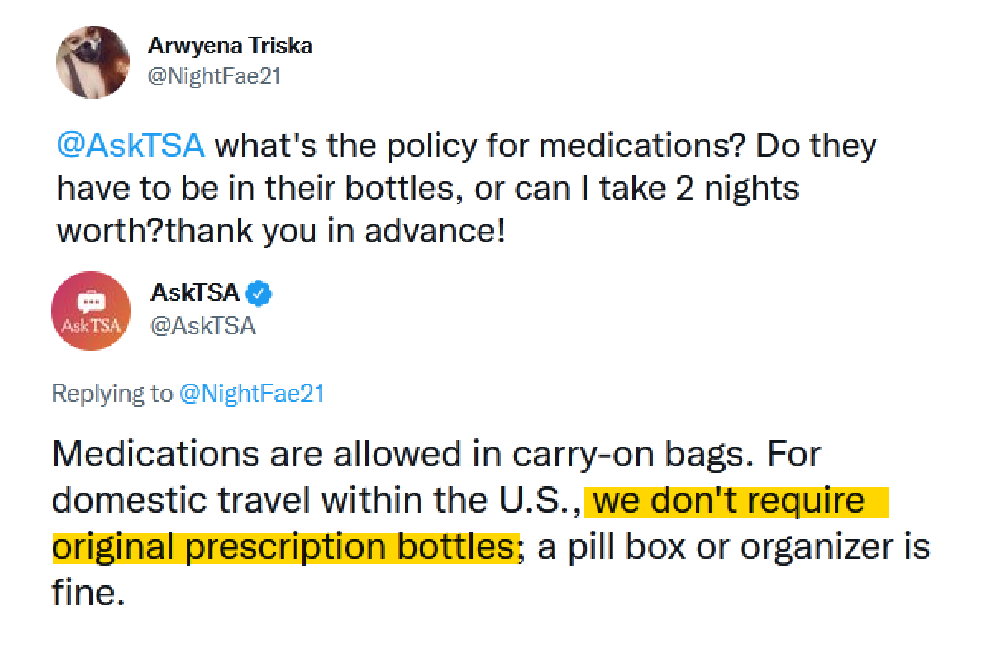
The TSA folks replied that medications are allowed in carry-on bags, and for domestic travel within the U.S., the TSA doesn’t require original prescription bottles; a pill box or organizer is fine.
Can You Take Medications in Carry-on Baggage?
There are no limits on the amount of medicine you can take in your carry-on baggage.
The TSA website states that you can bring medications in carry-on bags without any problem.
In fact, it’s much safer than placing them in your checked luggage.
That way, you don’t have to worry about them getting thrown around or damaged during the flight.
Just make sure they are well protected and packed. Also, keep your medications handy and put them in your personal item or handbag.
That way, you don’t have to open your suitcase or reach into the overhead compartment during the flight.
Can You Take Medications In Checked Baggage?
Sometimes, bringing medication in checked baggage is not a good idea unless it’s absolutely necessary.
It can be a bit risky, so you’ll need to secure them as much as possible.
Make sure they’re well protected and packed, and that they fit safely in the middle of your suitcase.
Also, be sure your suitcase respects the allowed weight so you don’t have to pay any extra fees.
| Medications | Typical size | Allowed in carry-on | Allowed in checked bag | Do you need to declare? |
|---|---|---|---|---|
| Ibuprofen (Advil) | Tablets (small bottle) | Yes | Yes | No |
| Acetaminophen (Tylenol) | Tablets / capsules | Yes | Yes | No |
| Benadryl (Diphenhydramine) | Liquid (100–250 ml) / tablets | Yes | Yes | Yes (if liquid) |
| Cough Syrup | Liquid (100–200 ml) | Yes | Yes | Yes |
| Insulin | Liquid vials / pens | Yes | Yes | Yes |
| EpiPen (Epinephrine) | Injection pen | Yes | Yes | Yes (recommended) |
| Inhaler (Albuterol) | Small aerosol device | Yes | Yes | No |
| Prescription Antibiotics | Tablets / capsules | Yes | Yes | No (domestic) / Yes (international) |
| Eye Drops | Liquid (10–30 ml) | Yes | Yes | No |
| Liquid Pain Relief (Children’s) | Liquid (100–200 ml) | Yes | Yes | Yes |
| Vitamins & Supplements | Tablets / gummies | Yes | Yes | No |
| Medical Syringes | Small medical tools | Yes | Yes | Yes (recommended) |
| Ointments / Creams | Semi-liquid (50–100 ml) | Yes | Yes | No |
Can You Take Medications on International Flights?
Do You Need to Declare Prescription Medication At Customs?
Carrying medicines on international flights is allowed, but keep in mind that countries may apply different rules.
Each country has its own regulations, and medications permitted to enter one country might be illegal in another.
So, you should visit the official government website of the country you are visiting and check what they say about bringing medicines into their country.
If the medicine is allowed, you will need to have a valid prescription, and the medicine should be in its original packaging.
For example, here is a summary of what the FDA says about bringing medications to the U.S.:
When traveling to the U.S., you must follow the rules of the FDA, U.S. Customs and Border Protection, and the TSA (Transportation Security Administration). Each authority may have different restrictions, so you should check with each of them.
Generally, you should have a valid prescription or a doctor’s note written in English to present at the airport. All your medications whether liquid or solid must be declared. In addition, your medications should be in their original containers and packaging.
If you don’t have the original container or packaging, you can bring a doctor’s letter explaining why you need the medication and under what conditions you should take it.
FDA
Here are the rules if you want to bring pills or other medications to Canada:
Prescription medications for legitimate health conditions may come under intense scrutiny by foreign officials. In some countries, drugs that are legal and readily available in Canada are considered illegal, require a prescription, or may raise suspicion among local authorities. It is always best to contact the foreign government offices accredited to Canada for the country you plan to visit to confirm the status of your medication.
Do Airlines Check Your Prescriptions?
Airlines don’t check your prescriptions. Nevertheless, when traveling domestically, airport security may check your prescription if needed, and your medications will undergo screening.
It’s a wise idea to clearly label your medications and transport them in their original containers.
This helps airport officers understand what the medications are for.
Internationally, you must declare prescription drugs at customs, and they may check your prescriptions.
You also need to check whether your medication is allowed in the country you’re visiting.
Where Do I Put My Prescription Tablets When Flying?

It’s highly advisable to take your pills in their original packaging and transport them in your carry-on baggage, so they are easy to access during your flight.
You can use a medicine organizer bag to keep your pills arranged in your carry-on bag.
Unless you’re bringing extra pills or a large quantity of medications, you most likely won’t be asked why you have more than you need.
Final Thoughts: Do I Need To Declare Medication At The Airport?
There’s nothing stopping you from taking your medications in your carry-on or checked luggage.
Domestically, it is not necessary to declare your medications at the airport. However, when traveling with liquid medications, they must be declared to the TSA officer.
Medications in liquid form are allowed in quantities larger than 3.4 oz / 100 ml in carry-on baggage.
I hope this helps.
Happy travels.
FAQs about flying with medication.
Do you need a doctor’s note to fly with medication?
For most domestic flights, you don’t need a doctor’s note. But if you’re traveling internationally or carrying stronger prescription medication or drugs, it’s a smart idea to bring one just in case customs asks for proof.
Do you need to put prescription medications in their original packaging when flying?
For domestic flights, it’s not strictly needed, but it will definitely help speed things up at security. For international travel, you should always keep medications in their original packaging to avoid any issues at customs.
Can airport security open my medication containers?
Yes, If something needs extra screening or isn’t clear, the security folks may open your medication to check what it is. This is normal and usually take few minutes.
What happens if you don’t declare medication at customs?
If your medication is restricted in that country and you don’t declare it, it could be taken away and you might face delays or fines. It’s always better to declare anything you’re unsure about when traveling internationally.
Do TSA officers check pill bottles?
Usually, no. TSA officers don’t typically check prescriptions for domestic flights. But they may look at or inspect your pills if something needs clarification during screening.
Can I carry controlled substances on a plane?
Yes, but you should be careful. Always keep controlled medications in their original packaging and bring your prescription with you, especially for international travel, where rules are stricter.
How do to pack medication for long flights?
Keep your medication in your carry-on bag, not checked luggage. Make sure you have enough for the whole trip (plus delays), and keep it easy to access during the flight.
Can I take multiple types of medication on a flight?
Yes, you can bring different medications with you. Just keep them organized so security can easily identify them if needed.
Do different countries have different medication rules?
Yes, and this is very important to know. Some countries allow common medications, while others will not allow them. Always follow the rules of your destination country.
People also ask:
- Can you take vitamins in checked luggage?
- Does a Medical Bag Count As Carry-on Luggage?
- Can You Bring Advil On A Plane?
- Can I Bring Tums On A Plane?
- Can I Bring Cough Drops On A Plane?
- Can You Bring Syringes On a Plane?
- Can You Bring An Inhaler On A Plane?
- Can I Bring Ointment On a Plane?
- Can You Take a Rollator On a Plane?