So, can you bring flour on a plane?
Traveling with some items can be tricky and confusing, especially with certain objects for which the majority of airlines do not provide clear instructions, such as food items. If you are planning to take flour with you on your next flight, you might wonder how much is allowed and what the TSA regulations are regarding traveling with flour.
Here is the short answer: You can bring flour on a @plane in both carry-on and checked bags without any limits. However, when taking more than 12 oz / 350 ml / 340 grams, it will be subject to additional screening. It is better to pack any large amounts of flour, or powders in general, inside your checked luggage to avoid any inconvenience at the airport.
This post explains everything about traveling with flour, the TSA rules within the United States, and the airline regulations when taking flour in both carry-on and checked baggage.
Let’s dive right in.
TL;DR
- You can bring flour on a plane without any quantity limits.
- Flour is allowed in both carry-on and checked luggage.
- Amounts over 12 oz / 350 ml / 340 grams require additional TSA screening.
- Flour does not need to go in the 3-1-1 liquids bag.
- Small quantities are easy to carry in hand luggage.
- Large amounts are best packed in checked baggage to avoid delays.
- TSA may open your bag for inspection if you carry a lot of flour.

Can You Bring Flour Through TSA?
According to the TSA, you are allowed to take flour through the security checkpoint without any problem. However, if your flour is more than 12 oz / 350 ml / 340 grams, it must be placed in a separate bin for X-ray screening.
Flour and other powder products will require additional screening at the airport, and containers may need to be opened.
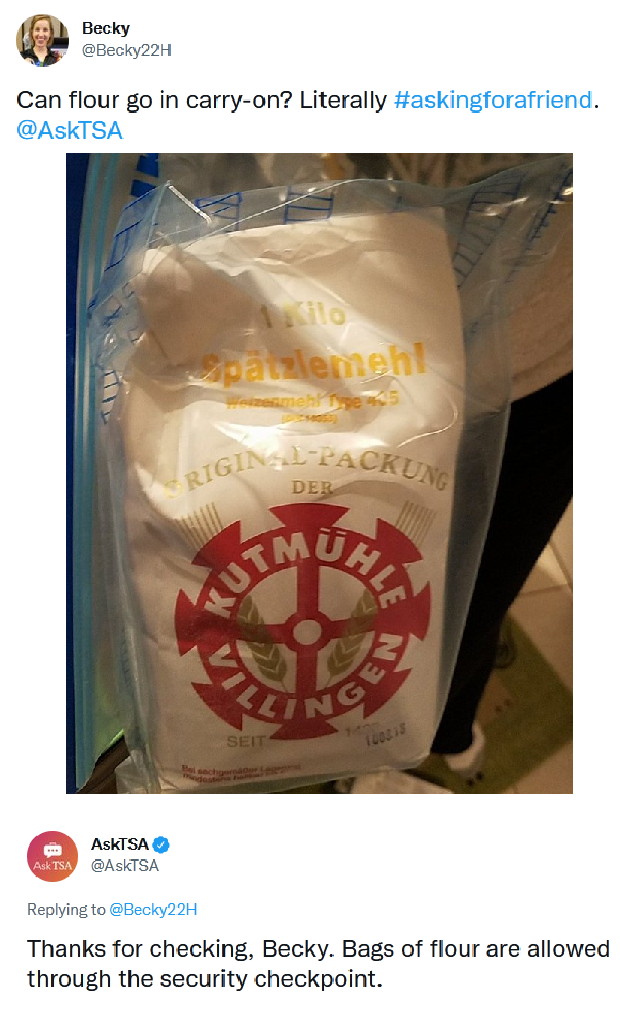
This is an answer from the TSA team on X.
Becky asked the TSA if flour is allowed through the security checkpoint, and TSA customer service replied that bags of flour are allowed without any problem.
Does Flour Need To Go In The 3-1-1 TSA Bag?
No, you don’t need to place your flour in a quart-size bag.
Powder rules are different from liquid rules.
The only difference is that powders may necessitate additional screening at the airport.
Traveling with less than 12 oz / 350 ml / 340 grams does not have any special restrictions.
Can You Take Flour In Hand Luggage?
You can bring flour in carry-on baggage. In fact, it’s safe to do so, especially for small quantities.
There are no limits to the amount of powder you can bring in your carry-on luggage.
The only thing you should consider is your airline’s carry-on luggage size and weight restrictions.
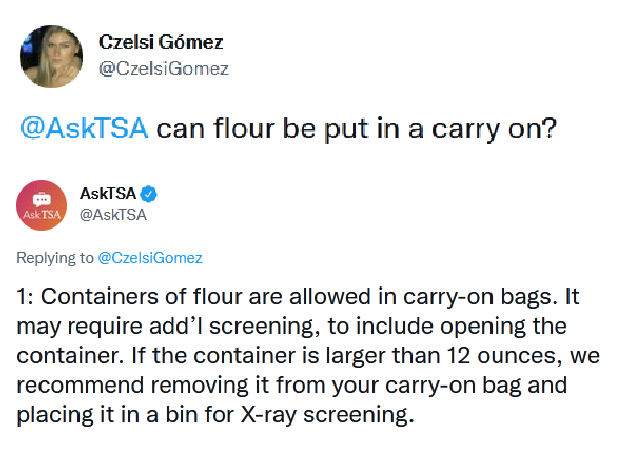
Czelsi asked the TSA if she could put flour in her carry-on baggage, and TSA replied that flour is allowed in carry-on baggage.
However, if she takes more than 12 oz / 350 ml / 340 grams, she will need to remove it from her carry-on bag at the security checkpoint for separate screening.
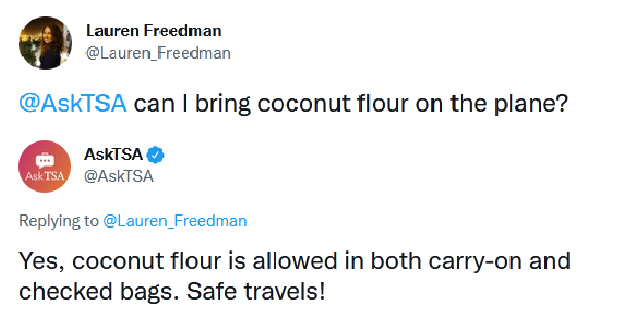
You can even bring coconut flour on a plane, like Lauren.
Can You Bring Flour In Checked Luggage?
It is better to pack large quantities of flour in checked baggage to avoid questions at the security checkpoint.
Taking a large quantity inside your checked bag will also save you space for carry-on.
But make sure that you stay within your airline’s checked baggage allowance to avoid additional fees.
The TSA might open your suitcase for extra inspection, so you should ensure your flour is well-protected and fits securely in your bag to avoid spills.
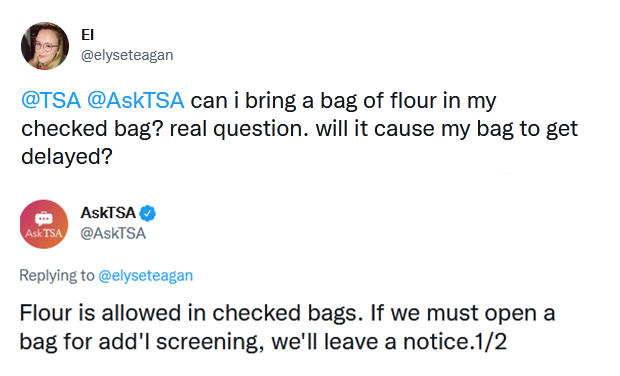
El asked the TSA about transporting a bag of flour in her checked bag and whether it would delay the bag if TSA searches it.
The TSA replied that if her bag is opened, they will leave a notice.
How Much Flour Can You Bring On a Plane?
There are no limits to the amount of flour you can bring on a plane.
You can take as much as you want in both carry-on and checked baggage, but you should consider your luggage regulations.
If you’re bringing reasonable quantities, there shouldn’t be any problems. Large quantities may prompt TSA to ask a few questions.
Can You Bring Flour On International Flights?
Yes, you can bring flour on an international flight, but there are a some rules to keep in mind:
You can bring flour in your carry-on, but if you’re packing a lot, it might get a bit more attention at security.
But for checked bags flour is generally allowed with less restrictions.
Some countries restrict or prohibit food products, including flour, to prevent pests or contamination.
You may need to declare it, and it can be confiscated on arrival.
To avoid issues, pack flour in your checked bag, keep it sealed in its original packaging, and always check the destination country’s customs rules before traveling.
How Do You Pack Flour For Travel?
The best way to pack flour is to keep it in its original packaging, place it in a plastic bag, and then put it in your suitcase or backpack.
Secure the plastic bag to provide an extra layer of protection and prevent spills.
You can also pack flour inside Ziploc bags, dividing it into smaller portions if needed.
If you take a small amount of flour and have space in your carry-on, try to pack and secure it inside your carry-on bag.
Final Thoughts
You can bring flour on a plane in both carry-on and checked baggage.
When going through airport security, remove flour if it exceeds 12 oz / 350 ml / 340 grams and place it in a separate bin for additional screening.
Traveling with flour internationally requires checking the regulations of your destination country regarding food items.
I hope this helps
Happy travels
People also ask:
- Can You Bring Rice On a Plane?
- Can You Take Peanut Butter On a Plane?
- Can You Take Bread On a Plane?
- Can You Take Yogurt On a Plane?
- Can I Bring Pancake Mix On a Plane?