There are numerous types of car parts, and if you are flying with one of these components, you might be wondering if you can bring car parts or engine pars on a plane?
Here is the short answer:
Yes, you can bring car parts on a plane in carry-on and checked luggage, but they need to be completely free of gasoline, oil, or any other residues. Any car parts you bring need must fit within size / weight restrictions or be checked as oversized baggage. Parts that have held fuel generally need special handling or are prohibited by some airlines.
In this post I will cover everything you need to know about taking car parts in both carry-on and checked luggage, in domestic and international flights.
Le’s dive right in.
TL;DR
- You can bring most car parts on a plane in both carry-on and checked baggage as long as they are completely clean and free from fuel, oil, or other hazardous residues.
- Small parts usually fit in carry-on bags, while larger or heavier components may need to be checked or shipped separately.
- The TSA generally allows clean car parts, but security officers and airlines have the final say.
- Always pack parts securely and protect sharp edges.
Can You Take Car Parts Through The Security Checkpoint?
The TSA stated that car parts without fuel or gas inside are permitted through the security checkpoint and in both carry-on and checked baggage.
Here is what the TSA has to say on its website.

You can carry car parts through the security checkpoint.
Most airport security officers do not worry about the accessories themselves, but rather what they may contain inside them, like fuel or other types of liquids.
And as the TSA always states, the final decision on whether an item will be allowed on the airplane is up to the security officer at the airport.
Even if an item is permitted on the TSA website, the security officer has the final say on whether to let you take it on board the airplane.
Some car parts may be subject to additional screening to make sure there’s no trace of fuel or other hazardous materials inside them.
TIP
Can You Take Carry-On Luggage Restrictions?
Now that you know you can bring car parts in carry-on luggage if they are free from any liquids, you will also need to comply with your airline’s carry-on size limits.
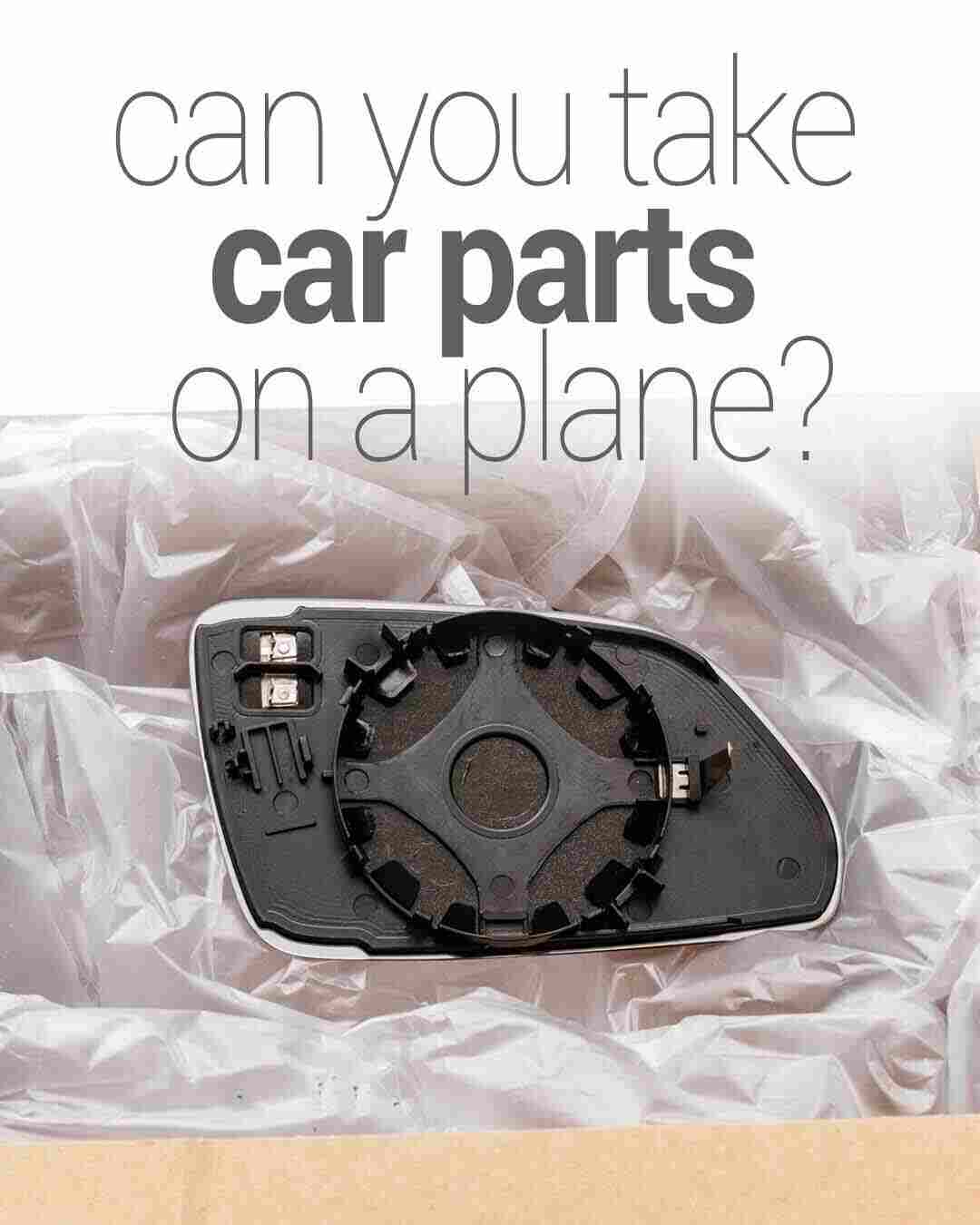
Small pieces like side mirrors are easy to carry.
You can just place them inside your carry-on and head to the airport.
On the other hand, if you are taking large pieces (like a front bumper), it is better to contact your airline, send them a picture of your item, or just send it as checked baggage.
Wes wanted to bring this pair of headlights on the plane, and TSA customer service replied that “Car parts, including headlights, are allowed in carry-on and checked bags.”

The problem, though, is that he still needs to confirm with the airline, as the headlights seem to be slightly larger than what the airline would normally allow in carry-on luggage.
The carry-on bag needs to fit in the overhead bin properly, and even though there is no weight limitation with TSA, the carry-on should still be light enough to be moved without any help.
Can You Take Car Parts In Checked Baggage?

As mentioned above, you can bring car parts in checked luggage on most airlines.
However, there are some risks that your pieces may be lost or damaged if they are not packed properly.
Also, make sure that you pack your car parts safely and securely especially if they have sharp edges so that anyone searching your bag will not injure themselves.
Ensure that you tag them with fragile item stickers so airport security agents or baggage handlers will handle them carefully.
You can save money by shipping your car parts and make your life a whole lot easier.
Tiffany wanted to bring an alternator for a 74 Volvo on her flight, and she had already traveled with it in 1993 without any problem. But that was before the TSA was even founded.

The TSA replied that car engine parts are allowed only in checked baggage.
But even then, I don’t think they will have problems with used car engine pieces if they are well cleaned and packed neatly.
Clean and well-organized packaging will increase the chances that the security officer will not remove the piece from checked baggage.
Another thing to remember is the weight of your car part.
Some engine parts can be heavy and may weigh more than the amount allowed in checked baggage, and I doubt there will be an airline that accepts extremely heavy items, even as overweight luggage.
| Car parts | Carry-on bag | Checked bag |
|---|---|---|
| Car headlights | Yes | Yes |
| Side mirrors | Yes | Yes |
| License plates | Yes | Yes |
| Alternator belt | Yes | Yes |
| Car scanner / OBD scanner | Yes (may need additional screening) | Yes |
| Car alternator | Yes, if completely clean and free from oil or fuel | Yes |
| Car shock absorbers | Yes, if they do not contain compressed gas or oil residue | Yes |
| Tire chains | Yes, but may require additional screening | Yes |
| Spark plugs | Yes | Yes |
| Brake pads | Yes | Yes |
| Brake rotors | Usually yes, if within size limits | Yes |
| Windshield wipers | Yes | Yes |
| Hubcaps | Yes | Yes |
| Air filters | Yes | Yes |
| Oil filters | Only if completely unused and clean | Yes |
| Fuel injectors | Only if completely drained and cleaned | Yes |
| Radiator | Usually yes if fully dry and clean | Yes |
| Muffler / exhaust parts | Yes if clean and residue-free | Yes |
| Steering wheel | Yes | Yes |
| Car stereo | Yes | Yes |
| GPS unit | Yes | Yes |
| Engine block | Usually too heavy for carry-on | Yes, if within airline weight limits |
| Full car engine | No | Oversized cargo or shipping usually required |
| Wet car battery | No | Usually prohibited |
| Sealed dry battery | Airline approval may be required | Airline approval may be required |
| Lithium car battery | Usually prohibited | Usually prohibited |
| Gas tank / fuel tank | No if it contains fuel vapors or residue | Often prohibited unless professionally cleaned |
| Airbags | No | No |
| Nitrous oxide systems | No | No |
| Compressed gas cylinders | No | No |
Final Thoughts
You are permitted to take clean and normal car parts in carry-on luggage or checked luggage.
But if a car item has fuel or gas inside it, it will not be accepted in either carry-on or checked baggage.
You should always empty any liquids from your car parts so you won’t face any issues with airport security.
Remember also that your items must be within your airline’s carry-on or checked baggage size and weight limits.
If the item is too large to bring on the airline, it is better to select a different method of transport for it.
I hope this helps.
Happy travels.
Frequently Asked Questions About Bringing Car Parts On A Plane
Can you bring car parts on international flights?
Most clean car parts are allowed on international flights if they are free from fuel, oil, and any hazardous residue.
Do you need to declare car parts at customs?
Sometimes. Expensive or brand-new parts may need to be declared, especially on international trips. Keep your receipts with you.
Can TSA confiscate car parts?
Yes. The TSA can remove parts that contain fuel, oil, compressed gas, or anything considered hazardous or suspicious.
How to avoid the TSA confiscate car parts?
Clean them thoroughly, remove all liquids, cover them them securely, and follow airline size and weight limits.
Can you bring a car battery on a plane?
Usually no for standard wet car batteries. Some sealed or dry batteries may be allowed but with airline approval.
Are lithium car batteries allowed in checked baggage?
Large lithium car batteries are usually prohibited in checked baggage because they are a fire risk.
Can you bring a car engine on a plane?
Small engine parts are usually allowed. Full engines are often too heavy or oversized for regular baggage.
Can you fly with an engine block?
Yes, if it is completely clean and within your airline baggage limits. But you might need to ship heavy engine blocks.
People also ask:
- How to Pack and Carry Fragile Items on a Plane?
- Can I Bring My Keys On a Plane?
- Can I Take a Jump Starter On a Plane?
- Can You Take A License Plate On A Plane?