
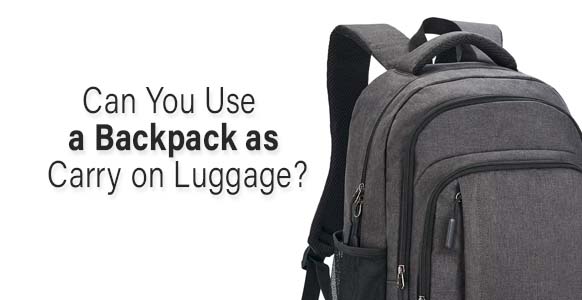
As a frequent traveler, I’ve lugged around the world using both backpacks and suitcases as carry-on luggage, and if you still wonder whether a backpack can be used as a carry-on or not, you’re not alone.
The short answer is: Yes, a backpack is a convenient and practical choice for carry-on luggage, and you can use it as a carry-on if it fits your airline’s carry-on size and weight restrictions.
So let’s find out.
In this blog post, we will answer all your questions about using a backpack as a carry-on and provide tips for taking your backpack on board stress-free and avoiding any inconvenience.
Let’s dive right in.
TL;DR
- You can use a normal backpack as carry-on luggage, but it must be within your airline size and weight limits.
- You can place your carry-on backpack in the overhead compartment.
- You can use a small backpack as a personal item if it fits under the seat in front of you.
- A 30–40 liter backpack can be a practical carry-on size, but always check its actual dimensions.
- If your backpack is too large or heavy, the airline may ask you to check it and potentially pay a baggage fee.

So Is A Backpack a Carry-on Bag?
Yes, you can use a regular backpack as carry-on or personal item, but you will need to make sure that it is within your airline’s carry-on size and weight limits.
Your backpack must fit either in the overhead compartment or under the seat in front of you.
If you are taking a large backpack that exceeds the airline carry-on size, then your backpack will be considered as a checked bag.
What Size Backpack Is Considered Carry-on?
Each airline has its own carry-on size restrictions (check this luggage calculator), but the most common carry-on size is 22 x 14 x 9 inches.
This size is usually for a 20-inch suitcase, so if you are planning to take a standard backpack, I’m sure the backpack won’t be bigger than this size.
And because most airlines are strict with their carry-on size, a backpack of less than 40 liters in this size range will be just the right size to go with.
If you encounter some less experienced airline staff, they may tend to check in your backpack if they assume that it is oversized or there is no room in the overhead compartment.
Like what happened to Melanie, when the United Airlines staff made her check in her backpack, but this doesn’t occur frequently.

Things To Consider Before Taking Backpack As Carry on Luggage
Size and Weight
As I mentioned earlier, most airlines have size and weight restrictions for carry-on luggage, including backpacks.
So ensure you choose a backpack that fits within the airline’s size limit and is lightweight.
Packing Efficiency
Backpacks can be tricky to pack efficiently, but with some prior planning, you can maximize the space and minimize the weight of your backpack.
You can use packing cubes or compression bags to organize your items and clothes and eliminate air pockets.
Take only what you need to ensure your backpack can easily fit into the overhead compartment or under the seat in front of you.
TSA Regulations
Ensure that you have some knowledge about the items that you are allowed to take in carry-on baggage.
Don’t place any prohibited items in your backpack, such as large quantities of liquids, sharp objects, and firearms.
Also, be prepared to remove your backpack during the security screening process.
Types of Backpacks
There are several types of backpacks that you could travel with. However, the type of backpack you take depends on your preference and the type of your trip:
Travel Backpacks
Travel backpacks are larger backpacks designed specifically for longer trips.
They have more compartments than a daypack to store more items, and they come with additional features, like locking zippers and padded straps for added security and comfort.
If you are planning to use one of these backpacks, ensure that it does not exceed 22 x 14 x 9 inches.
Wheeled Backpacks
Wheeled backpacks are convenient for those who prefer to have the option of rolling their backpacks instead of carrying them.
They usually have a telescoping handle, durable wheels, and padded straps that can be tucked away when not in use.
If you are measuring your wheeled backpack, ensure that you include the wheels and handles, just like a suitcase.
Hiking Backpacks
Hiking backpacks are bulky backpacks designed to carry heavy items and gear.
Usually, larger hiking backpacks will be accepted as a checked bag unless your backpack is within the airline’s size limits.
Daypacks
Daypacks are lightweight and small in size, making them perfect for short hikes, day trips, or as a personal item on a flight.
They usually have small pockets and one main compartment.
Alternatives To Backpacks
If you find that a backpack isn’t the right fit for you, there are many alternatives to use as carry-on baggage.
Here are some alternative options:
Wheeled Suitcases
Wheeled suitcases are a popular and good choice for traveling.
Suitcases have a hard exterior shell that protects your belongings and fragile items.
You can find them in various sizes, shapes, and colors, and the good news is that most luggage factories are aware of how to make suitcases that respect airline size and weight policies.
Duffel Bags
Duffel bags are also a popular choice. Even though they are not suitable for all trips, they are also lightweight and flexible.
If you are taking bulky items such as sports equipment or clothing.
The good thing about duffel bags is that they can be squeezed into the overhead compartment or under the seat in front of you with ease.
Tote Bags
Tote bags are a great choice, but they will work only as a personal item. You can’t count on them if you are traveling on a 2-week trip or more.
They are stylish and come in various sizes, but you can only use them for small stuff like electronics.
Final Thoughts
Using a backpack as a carry-on has plenty of advantages.
It’s easy to carry, leaving your hands free to hold other items.
It can also fit easily into the overhead compartment or under the seat in front of you, allowing for easy boarding and onboarding during the flight.
Just ensure that your backpack is within your airline’s carry-on size and weight restrictions, and you won’t face any issues at the airport.
I hope this helps.
Happy travels.
FAQs About Using a Backpack As Carry-on Luggage
Can you bring two backpacks on a plane?
Yes of course you can bring two backpacks if your airline allows one carry-on and one personal item, but the second backpack needs to be small to fit under the seat in front of you.
Can you bring a backpack and a carry-on suitcase?
If your airline allows both a carry-on bag and a personal item. In this case, your suitcase would usually go in the overhead compartment, while your smaller backpack would need to fit under the seat.
Can you bring a backpack as a carry-on for free?
Some airlines include a free carry-on, while others only allow a small personal item, especially budget airlines.
Do airlines actually measure backpacks?
Yes, airlines can take a look at your backpack dimensions if they think it is too large. They may be more likely to check it if it looks oversized or if there is limited space on the plane.
What happens if your backpack is too big for a carry-on?
If your backpack exceeds the airline’s carry-on size limit, you may be asked to check it. Depending on your ticket, you may also have to pay a checked baggage fee.
What is the best backpack size for a carry-on?
A backpack around 30 to 40 liters can be a practical size for carry-on travel, but you should always check its actual dimensions.
Is a backpack better than a suitcase for carry-on?
It depends on your trip. A backpack is easier to carry through airports, stairs, and places with uneven streets, while a suitcase can be easier to pack and organize.
Does a 40-liter backpack count as a carry-on?
It can, but the number of liters alone does not determine whether your backpack is allowed as a carry-on. What matters is whether its actual dimensions and weight are within your airline’s limits.
Do carry-on backpack dimensions include the straps and handles?
You should measure the backpack at its full external size and follow your airline’s instructions. If your backpack has wheels, handles, or other parts that extend beyond the main bag, include them when measuring.
People also ask:
- Is a backpack considered a personal item?
- Can a weekender bag be a personal item?
- Are North Face Backpacks Good?
